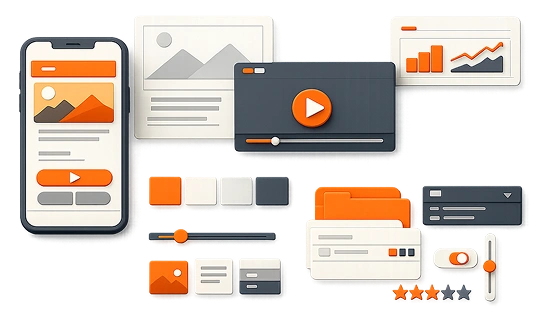
What We Deliver
End-to-end ui/ux design.
Our team combines strategy, design, implementation, quality, and ongoing optimization in one connected delivery model.
User research
User research delivered with business context, clear milestones, and measurable outcomes.
Discuss this capability→Journey mapping
Journey mapping delivered with business context, clear milestones, and measurable outcomes.
Discuss this capability→Information architecture
Information architecture delivered with business context, clear milestones, and measurable outcomes
Discuss this capability→Prototyping
Prototyping delivered with business context, clear milestones, and measurable outcomes.
Discuss this capability→Interface design
Interface design delivered with business context, clear milestones, and measurable outcomes
Discuss this capability→Design systems
Design systems delivered with business context, clear milestones, and measurable outcomes.
Discuss this capability→What We Do
Focused on the business challenge behind the service.
We align the work with business outcomes instead of treating delivery as a list of disconnected tasks.
Slow progress and unclear priorities.
We establish focus, scope, sequence, ownership, and measurable success.
Fragmented systems and inconsistent execution.
We connect people, process, technology, and reporting into one operating model.
Solutions that are difficult to maintain or scale.
We design for quality, adoption, operational fit, and long-term evolution.
our process
Clarity first. Momentum throughout.
Discover
Understand priorities, users, systems, and goals.
Define
Shape the roadmap, scope, and success measures.
Design
Create the experience, workflow, and solution model.
Deliver
Execute with quality, security, and transparency.
Validate
Test performance, adoption, and business fit.
Scale
Optimize and support long-term growth.
Core Capabilities
A complete delivery model for ui/ux design.
- User research→
- Journey mapping→
- Information architecture→
- Prototyping→
- Interface design→
- Design systems→
representative work
Solutions shaped around outcomes.
Replace this concept with a verified or anonymized case study during production content migration.
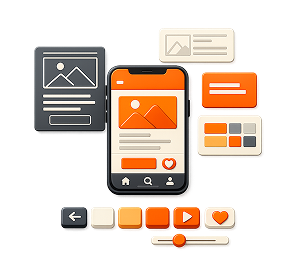
A focused ui/ux design engagement for a growing organization.
Strategy, implementation, integration, measurement, and ongoing optimization delivered as one connected program
More clarity. Faster execution. Better operating visibility.
platforms & tools
Technology selected for fit, not fashion.
Tools are chosen around your goals, internal environment, security requirements, and long-term maintainability.
Figma
FigJam
Adobe CC
Maze
Hotjar
GA4
Storybook
Miro
Notion
Zeplin
Faq
What to know before we begin.
How does user research influence the final interface?
Research helps identify user goals, context, terminology, decision points, and friction before visual solutions are finalized. Findings are translated into journeys, priorities, content structure, and interaction requirements. The interface is then evaluated against observed needs rather than based only on stakeholder preference or visual trends.
What is the difference between UX design and UI design?
UX design focuses on how the product is structured, understood, and used, including research, flows, information architecture, and interaction. UI design focuses on the visual and interactive presentation of that experience. They work together: a polished interface cannot compensate for a confusing workflow, and a good workflow still needs clear visual execution.
Will we receive an interactive prototype before development?
Yes, when a prototype will help validate the product. It may range from a simple clickable flow to a detailed representation of key screens and states. Prototypes allow users and stakeholders to test the direction before engineering investment, reducing rework and improving alignment around behavior.
Can you improve the experience of an existing product?
Yes. We can review analytics, feedback, support issues, workflows, interface consistency, accessibility, and technical constraints. Improvement may focus on a specific journey or a broader redesign. We preserve what works, prioritize the highest-impact problems, and plan changes that can realistically be implemented.
. What is included in a design system?
A design system may include foundations such as color, type, spacing, and accessibility, along with reusable components, states, patterns, usage guidance, and coded references. The scope is based on product complexity and team needs. A useful system improves consistency and delivery speed without becoming a separate product that no one maintains.
START A CONVERSATION
Ready to move your ui/ux design initiative forward?
Tell us about the challenge, current environment, and desired outcome. We will help define the right path.
VISIT6136 Frisco Square Boulevard
Frisco, Texas 75034