What We Deliver
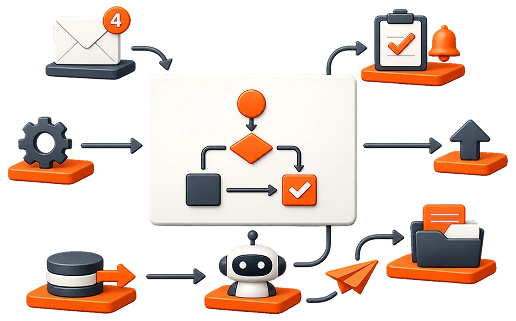
End-to-end workflow automation.
Our team combines strategy, design, implementation, quality, and ongoing optimization in one connected delivery model.
Process discovery
Process discovery delivered with business context, clear milestones, and measurable outcomes.
Discuss this capability→Automation design
Automation design delivered with business context, clear milestones, and measurable outcomes.
Discuss this capability→System integration
System integration delivered with business context, clear milestones, and measurable outcomes.
Discuss this capability→Approval workflows
Approval workflows delivered with business context, clear milestones, and measurable outcomes
Discuss this capability→Notifications
Notifications delivered with business context, clear milestones, and measurable outcomes.
Discuss this capability→Operational reporting
Operational reporting delivered with business context, clear milestones, and measurable outcomes.
Discuss this capability→Problems We Solve
Focused on the business challenge behind the service.
We align the work with business outcomes instead of treating delivery as a list of disconnected tasks.
Slow progress and unclear priorities.
We establish focus, scope, sequence, ownership, and measurable success.
Fragmented systems and inconsistent execution.
We connect people, process, technology, and reporting into one operating model.
Solutions that are difficult to maintain or scale.
We design for quality, adoption, operational fit, and long-term evolution.
our process
Clarity first. Momentum throughout.
Discover
Understand goals, users, systems, and constraints.
Define
Shape the roadmap, scope, and success measures.
Design
Create the workflow, experience, and solution model.
Deliver
Execute with quality, security, and transparency.
Validate
Test performance, adoption, and business fit.
Scale
Optimize and support long-term growth.
Core Capabilities
A complete delivery model for workflow automation.
- Process discovery→
- Automation design→
- System integration→
- Approval workflows→
- Notifications→
- Operational reporting→
representative work
Solutions shaped around outcomes.
Replace this concept with a verified or anonymized case study during production content migration.
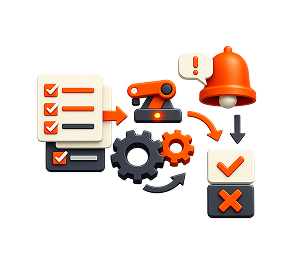
A focused workflow automation engagement for a growing organization.
Strategy, implementation, integration, measurement, and ongoing optimization delivered as one connected program.
More clarity. Faster execution. Better operating visibility.
platforms & tools
Technology selected for fit, not fashion.
Tools are chosen around your goals, internal environment, security requirements, and long-term maintainability.
Power Automate
Zapier
Make
UiPath
Azure Logic Apps
AWS Lambda
Salesforce
HubSpot
Slack
Teams
Faq
What to know before we begin.
Which workflows should be automated first?
We prioritize processes that are repetitive, rules-based, high volume, delayed by handoffs, or affected by manual errors. The workflow should have a clear trigger, defined inputs, predictable decisions, and a measurable outcome. Processes with frequent exceptions may first need simplification before automation provides reliable value.
Can workflow automation connect tools from different vendors?
Yes. Platforms such as Power Automate, Zapier, Make, UiPath, cloud services, APIs, and custom connectors can link applications across departments. We choose the integration method based on transaction volume, security, complexity, reliability, and maintainability rather than forcing every workflow into one automation tool.
How are approvals and exceptions handled in an automated workflow?
Approval rules can route tasks according to amount, department, risk, or other business conditions. Reminders, escalation, delegation, and expiration can be included. Exceptions are placed in visible queues with context and ownership so automation does not hide work that requires human judgment.
How do you prevent an automated workflow from creating bad data?
We include validation, required fields, duplicate checks, system-of-record rules, permissions, and controlled error handling. Test scenarios cover incomplete, conflicting, and unexpected inputs. Failed transactions are logged and routed for review rather than automatically writing unreliable information into downstream systems.
Can an automation be changed when our process changes?
Yes. Workflows are documented and designed in modular steps so rules, approvers, systems, and notifications can be updated. Change control and testing are important because a small process adjustment can affect several systems. Ongoing support can include monitoring, updates, and optimization.
START A CONVERSATION
Ready to move your workflow automation initiative forward?
Tell us about the challenge, current environment, and desired outcome. We will help define the right path.
VISIT6136 Frisco Square Boulevard
Frisco, Texas 75034