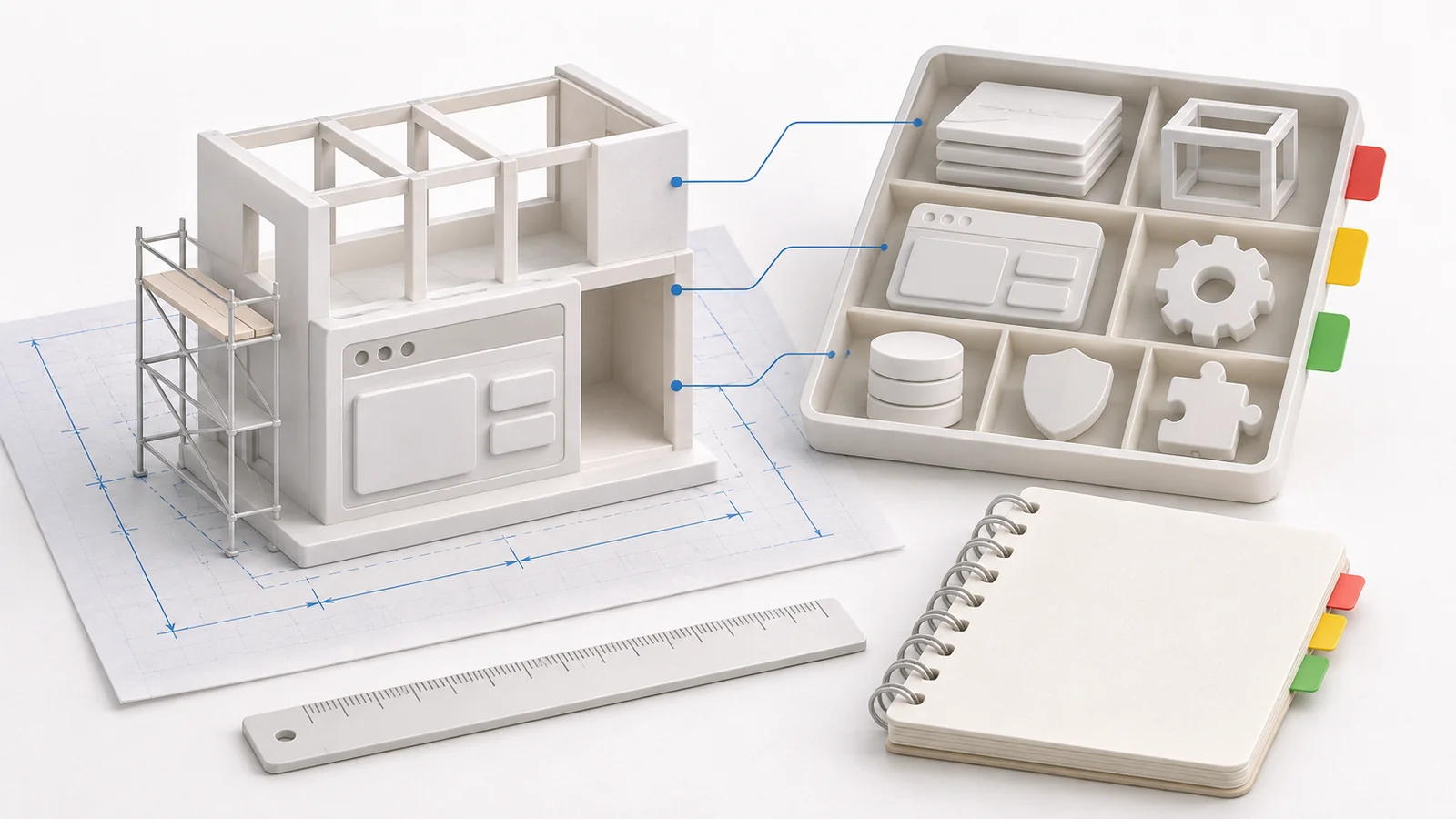
Custom software development cost depends on what the system must do, how reliably it must do it, which systems and data it depends on, and who will operate it after launch. A screen count or a list of features leaves much of that work unspecified. A useful estimate makes the work, assumptions and exclusions visible enough to discuss. Supplier rates, delivery models and commercial terms also affect price; the focus here is making the scope behind that price explicit.
This guide starts after custom development has become a credible option. If that decision is still open, use our custom software versus off-the-shelf framework first. Here, the goal is to prepare a scope that different teams can estimate on a comparable basis, without treating an unsupported price range as a project budget.
The tables and worked example are original planning aids. The repair-job tracker is hypothetical, not a Midwest Digital client result, quote or delivery commitment. Actual effort and pricing require review of your requirements, access, constraints and commercial terms.
1. Define one release before requesting a number
Write down the users, the job they need to complete, and the point at which this release ends. “Build a customer portal” could mean anything from viewing a status to managing orders, payments, messages and documents. Those are different scopes even if they share a product name.
A practical release statement might be: Staff can create and update repair jobs; supervisors can assign them; authorized users can view the current status and its history. Customer accounts, payment collection and inventory synchronization are excluded from this release. This is a hypothetical boundary to discuss, not a specification ready for implementation.
Then identify the evidence that will demonstrate completion: representative tasks, permission checks, data reconciliation, supported devices and a handover review. Name the person who can accept each deliverable. An attractive demo does not by itself establish that the release is ready for daily operation.
The GAO Cost Estimating and Assessment Guide describes an estimating process built around scope, schedule, a technical baseline, work breakdown, assumptions, risk analysis and updates using actual costs. We apply that general discipline here as a buyer planning method.
2. Ask what work each requirement introduces
The following table makes common sources of effort discussable. It is not a rate card, a ranking of cost percentages or a checklist of features every project needs. Ask the estimating team to identify which rows apply and how they have allowed for the work.
| Scope decision | Work it can introduce | Evidence to gather |
|---|---|---|
| Users and permissions | Sign-in, invitations, account recovery, role rules and record-level access checks. | A role-to-action matrix, account lifecycle and confirmed identity-provider access. |
| Workflow and exceptions | Status transitions, rework, cancellation, approvals and duplicate handling. | A normal task plus the exceptions staff handle today; an owner for each decision. |
| Connected systems | Field mapping, authentication, retry behavior, reconciliation and provider-specific constraints. | Current API documentation, permitted test access, sample responses and system owners. |
| Existing data | Cleaning, mapping, migration trials, rejected-record handling and reconciliation. | Representative samples, record counts, quality checks and a migration acceptance rule. |
| Quality and service expectations | Accessibility checks, performance testing, security review, backup and recovery exercises. | Agreed users, supported devices, workload assumptions and observable acceptance targets. |
| Release environments | Development/test/production setup, deployment, monitoring and rollback procedures. | Hosting ownership, access dependencies, deployment restrictions and support responsibilities. |
| Adoption and handover | Documentation, training, operational runbooks, knowledge transfer and support setup. | Who operates the service, what they must demonstrate and what support is included. |
An API connection is especially easy to underdescribe. “Connect the CRM” should identify records, direction, permissions, failure recovery and acceptance. Our CRM integration project brief provides a more detailed structure for those inputs.
If the scope includes AI, identify the evaluation examples, review workload, permitted actions and fallback behavior as work packages too. The workflow versus AI agents guide can help define the level of control before estimating implementation effort.
3. Separate confirmed inputs from guesses
An estimate can be useful before every question is resolved, provided the uncertainties are visible. For each assumption, record its status, the owner who can verify it, and what changes if it is false. Use confirmed only when there is supporting evidence; use assumed for a stated estimating basis, investigate for an unresolved item, and excluded for work deliberately outside the baseline.
| Estimating basis | Status | Verification owner and evidence | Impact to reassess |
|---|---|---|---|
| Existing sign-in service supports the required staff group | Assumed | IT owner verifies access, licensing and a test sign-in. | Additional account setup or a different authentication approach. |
| Historical jobs can be imported from the supplied export | Investigate | Data owner provides representative records and agreed reconciliation totals. | Cleaning, mapping, manual exceptions or a smaller initial migration. |
| Customers can sign in and see their own jobs | Excluded | Product owner records this boundary in the release brief. | A change request if customer access becomes necessary. |
| A supervisor can review working increments | Assumed | Business owner confirms reviewer availability and decision authority. | Review delays, rescheduling or unresolved acceptance decisions. |
Resolve the uncertainties that could change the design or estimate most before expanding detail elsewhere. A short technical investigation should have a question, an evidence deliverable and a stop condition. Its result may support a narrower estimate, reveal extra work or show that a different approach is needed.
If a supplier provides a range, ask which assumptions produce the lower and upper cases and what would narrow it. A precise-looking figure without an explanation is not more informative than a documented range. Avoid adding an arbitrary contingency percentage and calling the uncertainty solved.
4. Trace the impact of “one more screen”
Hypothetical change: the internal repair-job tracker now needs customers to view their own jobs. No hours, prices, schedule or implemented results are assumed in this example.
The visible page is only part of the change. The team must decide how a customer receives access and recovers an account, how jobs are linked to the correct customer, which internal notes must stay private, and how staff handle an incorrect association. If notifications are included, their triggers, wording and delivery failures also need decisions.
Acceptance now includes proving that one customer cannot read another customer's job, and that access changes behave correctly. Existing staff workflows still need regression checks. Documentation and support may need to cover external users as well as employees.
Record the change before revising the baseline:
- Request and reason: what customer task needs to be possible?
- Affected work: which data, permissions, interfaces, tests and operating procedures change?
- New or invalid assumptions: what information or access is missing?
- Assessment: what additional or removed effort, recurring cost and calendar dependency does the team identify?
- Decision: who approves the revised scope and estimate, and which version becomes the new baseline?
This record helps distinguish a change in requested scope from an estimating error or a delivery problem. Those situations deserve different explanations; they should not all be hidden under “additional development.”
5. Compare the same work, not just the total
Ask each team to walk through the same release brief and explain differences before choosing on price. Keep these questions beside the estimate:
- Does it include discovery, design, implementation, testing, release and handover? Are outputs and acceptance evidence named?
- Which integrations, migration tasks, user groups and environments are included? What is explicitly excluded?
- Which approvals, accounts, licenses, data and staff time must your organization provide?
- What evidence supports the effort estimate? Which uncertain items need investigation or an allowance?
- Is the commercial basis fixed price, time and materials, or another agreed structure? How are scope changes, billing and acceptance handled?
- What support, defect correction and later enhancements are included, and for what period? Who owns the source code and operational accounts under the proposed terms?
- What is the estimate date, revision, validity period and re-estimation trigger?
Effort and elapsed time are separate. Waiting for an external account or a business review can move a release date without representing continuous development labor. Conversely, running work in parallel does not remove the underlying effort. Request both the work estimate and the dependency-based schedule.
A lower initial total may reflect a smaller release, omitted work or different assumptions. Clarifying those differences is more useful than assuming every total describes the same finished system.
6. Keep delivery and ownership costs visible
Use separate lines for initial delivery, recurring services, retained internal effort and future changes. Assign each cost once so an activity included in a support fee is not also counted as a separate labor allowance.
- Initial delivery: the agreed build, migration, release and handover work.
- Recurring services: hosting, storage, backups, monitoring, external APIs and applicable licenses, based on documented usage and retention.
- Retained internal effort: product decisions, user administration, data stewardship, exception handling and review.
- Later work: dependency updates, support outside the included terms, new features and eventual migration or retirement.
For an AWS estimate, document the services, region, usage assumptions and estimate date. AWS explains that its calculator is an approximation based on entered usage; actual usage and prices can differ, and taxes and third-party licensing fees are excluded. A cloud calculator does not estimate the development team's work or the whole cost of owning the application.
Assess the expected benefit separately. Our automation ROI worksheet distinguishes released capacity from cash savings, so a delivery estimate is not mistaken for evidence that a project will pay back.
7. Bring evidence to the estimate discussion
Start with one release outcome, named user roles, a normal workflow and its exceptions, system/data samples, acceptance criteria, an assumptions register and explicit exclusions. Add known deadline constraints and the people available to review work. The fillable software project brief can organize the initial inputs; use the cost-driver and assumptions tables above to expose the remaining questions.
For a Frisco/DFW or U.S. project, share your workflow, current systems and release goal with Midwest Digital. We can discuss the scope and information needed for an estimate. Explore our custom software development service or call 469-468-2480. Include the decisions still open so the first discussion can focus on what would change the work.